
- Conflicts:
- First World War (1914-18), Second World War (1939-45)
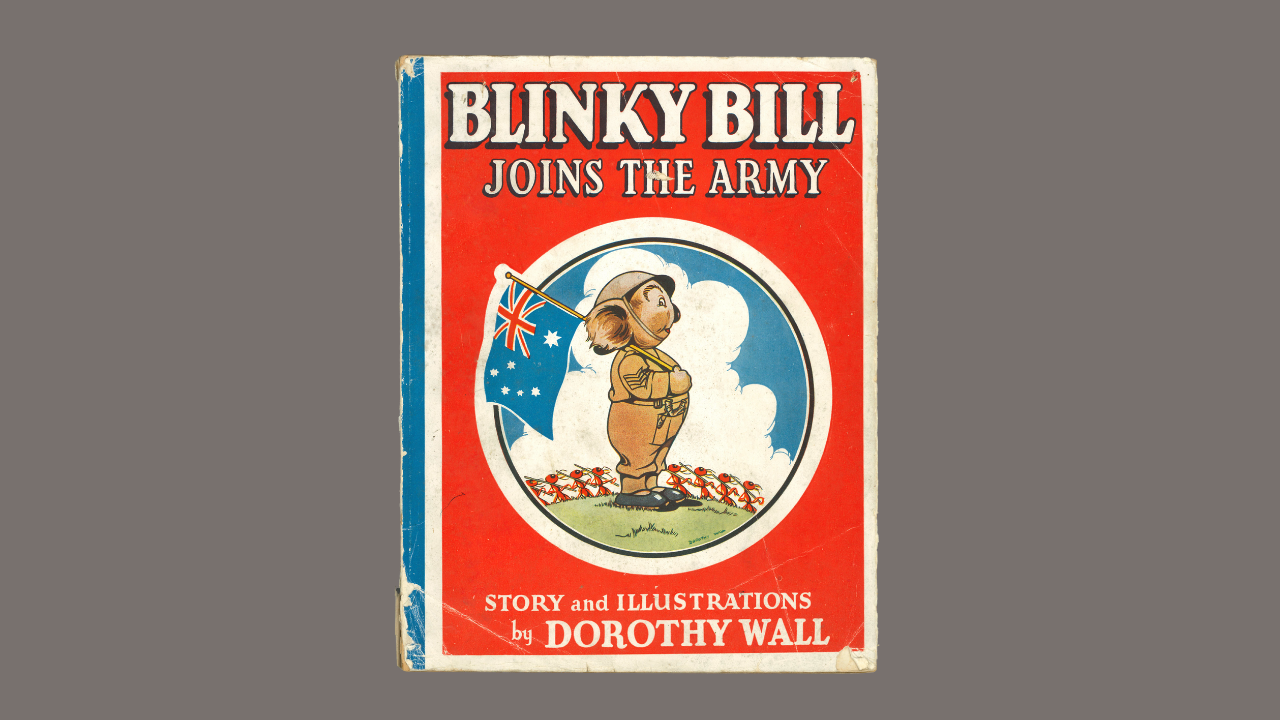
The Shrine recently acquired a copy of Blinky Bill Joins the Army (1943) by Dorothy Wall. This wartime children's book charmingly depicts Blinky Bill’s journey to becoming an army mascot, offering a whimsical lens on Australia’s military history.
The incorporation of animal mascots into military tradition is a longstanding cultural practice within Australia and abroad. During the First World War, servicemen of the Australian Imperial Force (AIF) were accompanied by a variety of native and non-native animals—including dogs, kangaroos, koalas and a Tasmanian devil—that served not only as companions but also as symbolic embodiments of national identity. These mascots played a significant role in boosting morale, evoking memories of home, and providing emotional relief amid the harsh conditions of warfare.
Like the soldiers themselves, animal mascots were at times actively recruited. Public appeals in newspapers solicited animal donations from citizens, and specific requests—such as calls for kangaroos and wallabies—were made to enhance morale within training camps.
However, the enthusiastic sentiment of early wartime efforts was soon tempered by practical concerns. Although servicemen formed strong attachments to their animal companions, considerations for their long-term welfare were often overlooked. When the first contingent was dispatched to Gallipoli, most of the mascots were donated to Cairo Zoo.
By the onset of the Second World War, the Australian military had shifted its policies, opting to keep mascots within domestic borders. These animals assumed roles in morale-building efforts and public fundraising campaigns, rather than accompanying troops abroad.
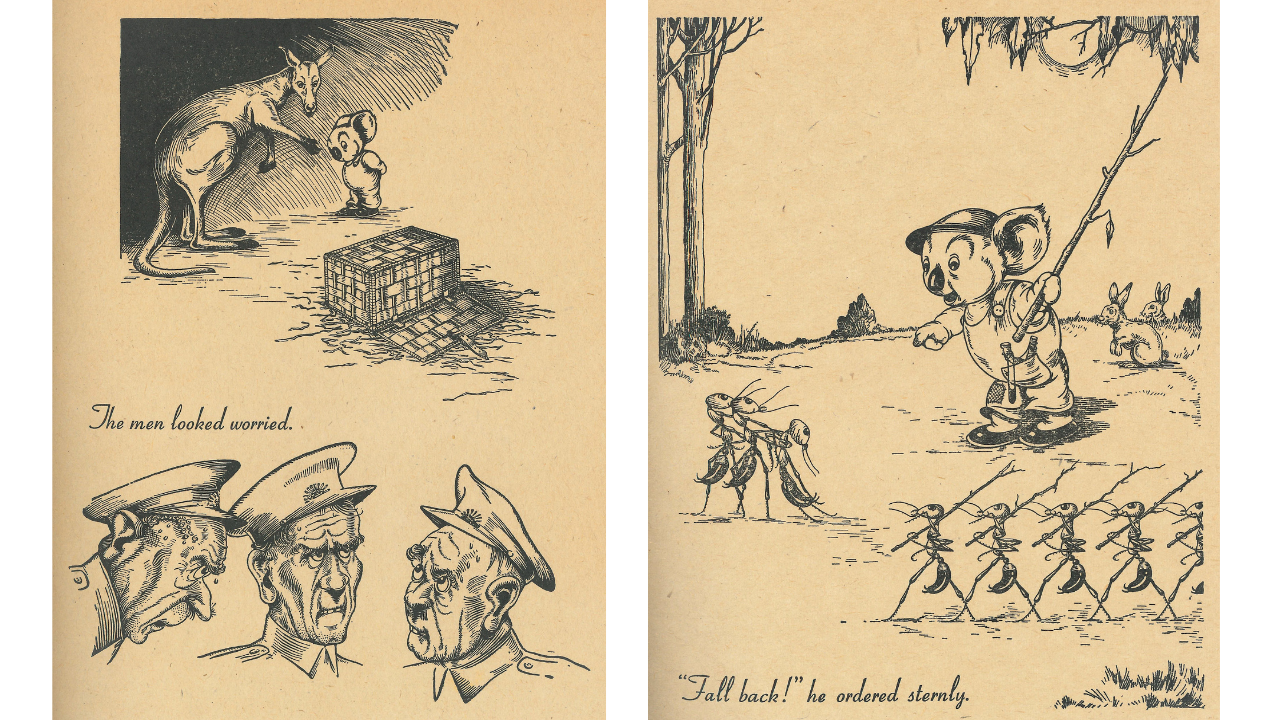
The Shrine of Remembrance recently acquired a copy of Dorothy Wall’s 1940 publication Blinky Bill Joins the Army, a book that understood well the plight of mascots during the First World War and keenly advocated for animals such as wallabies and koalas to remain in their natural habitats. As Wall begins her story, a group of local bush animals compete to become the mascot for the army in Sydney:
Once again the bushland was filled with excitement and chatter just as it was a few years ago when the news went round that Mrs. Koala had a baby. You all know Blinky Bill very well by now and again he is the cause of all this excitement. And what do you think it is all about? You'd never guess. He's [Blinky Bill] been chosen as the mascot for the Australian soldiers—not to go overseas of course, as that would never be permitted. All koala bears are protected as no doubt you know, and no one, not even Royalty, is allowed to have one. Why? I can hear you asking. I'll tell you in a few words the reason. These dear little creatures are very delicate. They catch cold very easily. So just imagine how quickly they'd die if sent from warm sunny Australia to a cold climate with snow and ice in the winter; and think of the bitter winds. Although the koalas have furry coats and look very cosy in the winter time, their coats would not be nearly warm enough to keep out the cold as a big ground bear's does.
Wall’s humour is evident on the front cover of the book, which depicts the officer Blinky in an army uniform carrying the Australian flag as he drills a column of marching red ants. Beneath the image, the usual army motto ‘Duty First’ is replaced with Blinky’s own motto, ‘Scratch & Kick’, a change that suggests Wall understood wild Australian animals were best left in the bush.
A committed advocate for Australia’s native flora and fauna, Wall used her portrayal of bush animals vying to become army mascots to reflect shifting attitudes to the environment. Following in the footsteps of May Gibbs, Wall created a vibrant world filled with anthropomorphised native creatures whose humorous escapades invited children to identify Australian values in the spirited larrikinism of Blinky Bill. Yet Blinky represented more than cheeky charm—his adventures became emblematic of a growing wave of Australian nationalism, one that anchored the nation’s character firmly in its unique natural landscape.
For soldiers embarking overseas, many for the first time, Blinky Bill Joins the Army served as a reminder of the distinctive way of life they were leaving behind and for which they were, in essence, fighting to keep. For children separated from family members by the war, Blinky Bill’s enlistment as an army mascot must have offered a welcome dose of cheer and escapism—a light-hearted distraction in a heavy time.
Author:
Toby Miller is the Collections Coordinator at the Shrine of Remembrance.
Enjoyed this article?
- Discover our permanent and temporary galleries on your visit to the Shrine.
- Have an item that you would like to donate to the Shrine collection? Contact us here.
Updated