
- Conflict:
- First World War (1914-18)
It's hard to talk about Christmas without discussing food. Whether it's a seafood buffet or a traditional roast, the festive season is a gastronomic delight.
But what happened during conflict? Were troops still able to celebrate with a warm meal?
Listen as the Shrine's Exhibitions and Grants coordinator Katrina Nicolson gets festive with frontline food.
Transcript
LAURA THOMAS: The Shrine of Remembrance embraces the diversity of our community and acknowledges the Bunurong people of the Kulin nation as the traditional custodians of the land on which this podcast was recorded. We pay our respects to Elders past and present.
KATRINA NICOLSON: It's hard to talk about Christmas without discussing food, whether it's a seafood buffet or a traditional roast, the festive season is a gastronomic delight. But what happened during conflict? Were troops still able to celebrate with a warm meal? Joining me today to answer these questions and many more, is the Shrine's Exhibitions and Grants coordinator, Katrina Nicolson, welcome, Katrina.
KATRINA NICOLSON: Hi. Thanks for having me. Merry Christmas.
LAURA THOMAS: Merry Christmas. I can't believe we're already here again. Now, let's go back to the First and Second World War. It's Christmas. Were there any roasts to be had?
KATRINA NICOLSON: Well, it very much depended on whereabouts you were, in terms of the front line, because if you were right in the firing line, then probably not. You might get lucky, and if it was a quiet, quieter moment, you would get, you know, perhaps your regular bully beef and biscuits, but you might also get some plum pudding, a slice of tinned plum pudding sent up the line by the by the cooks. But that was if you were lucky. But if you were behind the lines in a less active area, or if you were in camp or training, then you had a good chance of getting perhaps some turkey, although, as one chap, Samuel Braydon, said, his turkey was very tough, and he also got pudding, but it was like leather, so it might depend on the quality of your chef.
LAURA THOMAS: Okay, okay, so different experiences for where you were, did that count geographically as well if you were in a different country or area?
KATRINA NICOLSON: Yeah, I think so. Because if you were in, if you were in France during the First World War, for example, again, if you're behind the lines, you might get your roast. You might get some turkey. You might get some ham. Mutton was on offer, occasionally beef, because you were close to some source of supply in England. If you were in Egypt, it again depended on who your chef was, but also when your pay had come in, because there was a limited amount of budget for these types of things, for any extras, and the men would supplement what was on offer through their own pay. And so, we have records like one chap who said, 'Well, we didn't have a great day today. We had our ordinary rations, but wait until pay day, and then we're going to splurge'. And then they went into the closest town, and they bought some supplies, and they had a big, big feed, but it wasn't on Christmas Day.
LAURA THOMAS: Okay, so they had to be used to getting a bit of a rain check on their Christmas meal if they needed to.
KATRINA NICOLSON: Absolutely
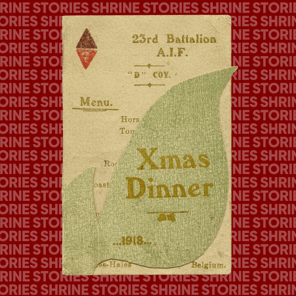
LAURA THOMAS: Now, we have a menu on display here in our galleries, and it's from Christmas 1918, so that's when the war, the First World War, was over, but many people were still overseas. Now, before we dive into the food on this menu, I thought it was worth noting that it's quite a unique design, this menu. So, can you describe it, Katrina, for our listeners?
KATRINA NICOLSON: Sure, this one's very beautiful and they had a bit more time. The war is finished. The hostilities at least are over, and what they've made is a proper little menu with a proper card front. So, the front of it is a beautiful gum leaf design. It's a lovely green, it's got Christmas spelled 'Xmas', which not my fave, but you know. It’s actually gold embossed on this beautiful green gum leaf. And you lift the cut-out gum leaf up, and there is the menu underneath. So, they had a bit of time to do that, and they also, by that stage, this was the 23rd battalion who were on the Western Front. They'd been there for quite some time, and they had their own little printing press that they used for, you know, issuing their orders and things like that. But they've used that to print the menu, and it's a really nice-looking piece. Most other menus that we've seen much plainer. They're just one sheet of paper, perhaps, or if they have got printing, it's all one colour, like it's just black on whatever colour card they had. So, this one's pretty special, and we're lucky to have it.
LAURA THOMAS: And what was on the menu for this Christmas lunch?
KATRINA NICOLSON: So, on their menu, they had for an hors d'oeuvre, they had tomato soup, they had a fish dish, but they don't tell us what they had. Now, I'm speculating it wasn't fresh fish, and it certainly wasn't the prawns that many of us enjoy today in Australia, but what I have seen on other menus, sardines on toast was a popular fish dish. So, I'm suspecting that it was possibly something like that. Although we have got one menu in our collection where they had, like a salmon rissole. So that was pretty posh.
LAURA THOMAS: Very posh and very obscure.
KATRINA NICOLSON: Yes, I think so. And I would suspect it was tinned salmon. I don't think anybody went fly fishing in the Seine.
LAURA THOMAS: Not even for Christmas
KATRINA NICOLSON: Not even for Christmas. So, they had a couple of joints. Which means they had roast beef, they had pork, they had roast potato and boiled cabbage. That's not terribly exciting, and carrots. For sweets, they had plum pudding and brandy sauce. They had custard and fruit, which again, tinned fruit, and they had cake. They had biscuits, they had nuts, they had fruit. And they were very, very swish, because they had cafe noir.
LAURA THOMAS: Very fancy
KATRINA NICOLSON: Yeah, so I think the French influence was rubbing off on them.
LAURA THOMAS: And it sounds like quite a comprehensive menu.
KATRINA NICOLSON: Yeah, I think they did pretty well. I think there's a combination of things happening there. It's because the war is over, things have freed up a little bit. But, you know, there was a real desire on the part of the Army, also to try and make something of these events, to try and make it a special day, if they could. Obviously, operationally, it doesn't always work. And as I said earlier, if you're right in the front line, it's luck of the draw, you know what you might get. But certainly, behind the lines, the army was making an effort to do things when and where they could to make something special.
LAURA THOMAS: And why do you think that was? Why was it so important to make an event of it?
KATRINA NICOLSON: Morale. Morale is one of the most important things about an army. We can talk about lots of things that make an army move and make men motivated to go to war and remain and perform their duties, but morale is one of the biggest things. And once upon a time, I think perhaps commanders didn't particularly concern themselves with that, but in modern warfare, and by that, I mean, you know, from the late 19th century onwards, it's very much a concern of commanders that the morale of the troops is good, and they want to make the most of any opportunity they have to raise that morale, and particularly if we're looking at this special menu in 1918, the war is over, but nobody's going home straight away, and especially for Australians. It actually took up to 12 or 18 months for Australians to get home after the war, because you can't send 100,000 people home instantly.
LAURA THOMAS: So, it's kind of that taste of home and that home comfort, despite being in an uncomfortable position.
KATRINA NICOLSON: Absolutely and Christmas is, even though, you know, people come from different faiths and different traditions, Christmas is, or particularly in those times, was a very universal time when people are thinking about families, they're thinking about home. They're thinking about what it means to be far away from home. So, to have some sort of event that marks that, I think is really important for them.
LAURA THOMAS: You mentioned before the fellow who said his meat was not incredibly well cooked. Do we have any other reflections from diaries of people who reflected on their Christmas meals in particular?
KATRINA NICOLSON: So, we have a diary from a man called Lionel Grimwade. And Lionel was actually in the Royal Navy because he had been sent overseas as a training Cadet to the Royal Navy before the war broke out, and he remained with the Royal Navy throughout the war. And in 1915 he was at Gallipoli. And many people will say, 'Well, we'd left Gallipoli by Christmas', but there were still British forces on Gallipoli at Christmas. They didn't evacuate until January, so his ship was in support. So, on Saturday the 25th of December in 1915 he wrote 'Church on the mess deck, and then he had half a glass of champagne. What loathsome stuff it is. However, they would not let me have anything else'. And then he had a pretty exciting time, because they were bombed by a German aeroplane. And he says, 'Our first aerial Hun came over and dropped some happy messages in the form of seven bombs, no real damage. Had our Christmas dinner at 7:30pm. Not up to much, but of course, one could not expect much else in a spot like this'. But then we have and this was a year earlier, December 1914, and this man's name is Shepherdson, 'We had Christmas day in the desert, and all the complaining that we could not have any beer for Christmas as the canteen had run dry, however, they fed us fairly well, roast beef, plum pudding, preserved fruits and pound cake'. So typical Australian no beer. It's not Christmas.
LAURA THOMAS: It's classic. And how has obviously, you mentioned the very diverse experiences of people back in the First and Second World War, in the different foods that they got. How has this evolved in more modern times and modern conflict?
KATRINA NICOLSON: Sure, the army definitely tried to make a special effort. And once again, it's a question of where you are during conflict. We have one menu from HMS Vendetta in 1965 and here we see a bit of a departure from those very traditional turkeys and roast beefs. And they had chicken, which was a, you know, that was pretty exotic in 1965 to have chicken for your Christmas lunch. But they still had, you know, plum pudding and brandy. They still had fruit and custard. They still had sweets and things like that. So, there was a real effort to make it traditional. And one of the most exciting things on that menu, I think for most of the chaps, would have been the icy cold beer that was on offer.
LAURA THOMAS: Again, I'm seeing a bit of a common theme here.
KATRINA NICOLSON: Well, there is a bit of a common theme, yes.
LAURA THOMAS: You mentioned earlier that despite Christmas being a very Christian tradition, it was embraced by a lot of different cultures and people within defence. Do you know if that's a similar thing now in the more modern defence force that other cultural traditions and holidays are acknowledged?
KATRINA NICOLSON: I can't say 100%, what I can say is that certainly Christmas is still a big, important day. And you know, if you are on active service, there is an effort, you know, to make it special. We still have beer, but it's non-alcoholic beer if you're on active service. If you're back in barracks or behind the lines, there'll be an attempt to make a Christmas meal. But other traditions, the army, it always was a diverse place. People forget that even during the First World War, we go back and there were people of the Jewish faith, there were people of Muslim faith, serving people from lots of different culture. There were many people from India who served in the Australian Army during the First World War, and they have a mixed set of religions, because they might be Hindu, they might be Muslim, they might be Sikh. So, there was a variety of people serving then. But of course, way back then, not as much acknowledgement of what was happening. There was an attempt to serve kosher meals to Jewish soldiers, where possible, not possible 100 per cent of the time during a war. Coming into the modern day, those things are much more paid attention to like in ration packs and things like that, there are particular meals set aside for particular religious observance. Now, everybody can choose to participate in something like Christmas. But you have to also remember that most cultures and most religions have some sort of festival and have some sort of gift giving tradition. Now, whether that gets manifested throughout the year with defence, I don't actually know the answer to but I do know that defence does respect culture and does allow people to have cultural leave, and particular religious leave, if that is required for different purposes.
LAURA THOMAS: And just because I'm curious, my last question for you is, what does Christmas look like in your household? What will you be having for Christmas lunch?
KATRINA NICOLSON: Well, traditionally, we do go down the prawn route. And quite a fan of the crayfish. Lobster for you know, people who prefer but we grew up with crayfish. So that tends to be something we have, and chicken is what we grew up with as being a festive food. My mother didn't cook her first turkey until she was 83, I think. And I still don't quite know why she did it, but we always had chicken because chicken was very special for us, because we had lamb a lot of the time, because my mum came from a farming family, and I don't think we ever bought a lamb. My uncle used to bring us in a lamb, so we had lamb roast all the time. So chicken was very that was exotic food for Christmas and Easter. And we always had ham, because one of our cousins brought us a ham every year. So that's what we had. And great boiled fruit cake, my mum's Christmas cake, which, sorry listeners, it's the best Christmas cake. And, you know, yeah, just a good day all round, basically.
LAURA THOMAS: Oh, wonderful. Well, I'm very much looking forward to my mum's Yorkshire puddings. I argue that they're the best as well. So, thank you so much, Katrina and Merry Christmas.
KATRINA NICOLSON: Merry Christmas, Laura, great to have been here.
LAURA THOMAS: Thank you for listening to this episode of Shrine Stories. For more, make sure you subscribe to our channel, wherever you listen.
Updated