
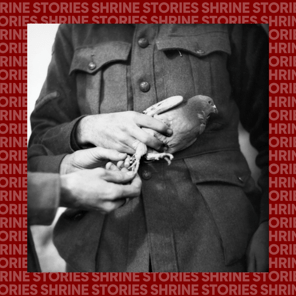
Pigeons. We love to hate them. But did you know they once played a critical and often life-saving role in military service?
In this episode, we uncover the remarkable role of pigeons in wartime and the stories of two feathered Dickin Medal winners who saved dozens of lives.
Correction: In this recording, it was stated that a pigeon travelled 65 km in 15 minutes. The correct timing is 65 km in 50 minutes.
Transcript
LAURA THOMAS: The Shrine of Remembrance acknowledge the Bunurong people of the Kulin nation, the traditional custodians of the land on which the Shrine stands, and pay our respects to their elders, past and present. As a place of remembrance and storytelling, we honour their deep connection to country and waterways shaped by generations of stories and memories.
LAURA THOMAS: Pigeons, we love to hate them. But did you know that they once played a critical and often lifesaving role in military service. Carrying messages under heavy fire, these birds were sometimes the only link for troops to call for help. Though often overlooked in our history books, their contribution has recently been recognised through two sculptures at the newly opened Anzac station, just down the hill from the Shrine of Remembrance. Joining me now to shed light on pigeons and their service is board member of the Australian National Racing Pigeon Board, Paul Gibbs. Thank you for joining me, Paul.
PAUL GIBBS: Yes, thank you, Laura. Thanks for the invitation. I'm looking forward to the interview.
LAURA THOMAS: Well, let's dive straight into it and talk about homing pigeons and when they were actually first used in war and what they were used for.
PAUL GIBBS: Homing pigeons got a long history going many centuries back and for biblical people, I suppose you can relate to the pigeon to Noah. Back in those biblical days, they said it was a dove. But the term dove and pigeon cross over a lot. Other than that, during times of conflict and wars, or just as a means of communications, pigeons can be traced right back to the Roman times, which they used as messenger pigeons, the Crusades during the 12th and 13th century, and used by many other older empires. Egyptians used them, the Greeks, the Indians, as messenger pigeons for both periods of conflict and just messengers going from one town to another. Apart from that, you know, you can start to look at war service, if you were looking for pigeons that served during the war. The early recorded history of pigeons used in war was during the siege of Paris in the late 1870s, 77 and the Franco Prussian war that were used as messenger pigeons through work, through that period of time. And then, of course, you know, we sort of gone on to about 1914, the beginning of World War One. You know, where pigeons were used quite extensively. Over 100 or they estimate, 100 to 200,000 pigeons were donated to the war effort, with all the services, the Army, the Navy, the Air Force, all using pigeons as a means of communications. And it's interesting to note that at that particular time, it was the Navy who was the first to establish a pigeon service, and that was about 1914, I think, couple of years later, the British Carrier Pigeon Service was formed, and the Army of Land Forces started to use pigeons for communications.
LAURA THOMAS: And why pigeons in particular? What about this bird made them the best for the job?
PAUL GIBBS: Well, there were several really good reasons why pigeons were used during time of conflict. They were very highly valued by the military people. Now the benefits mainly were that they were easy to transport. A single pigeon could be carried by individual troops. Small mobile lofts could be erected and towed behind vehicles from one part of the battlefield to another, and they required very little to eat. Generally, a pigeon will eat about an ounce of food a day, and they're quite happy to eat a range of different grains which could be carried by the different forces. So, they were very flexible in being able to be moved around, and easy to be fed.
PAUL GIBBS: They were also considered like, if you look at the First World War, they were considered as being much faster than a runner, which used to be used on a regular basis to run with a message from one area to another. The soldier on horseback, they were quicker than that, and people who have had to ride a push bike or a motorbike, especially when you look at some of the filming of World War One in the battlefields, where there are big craters from bombings, muddy fields, the roads weren't that crash hot. So, they were good there, because the pigeon could travel in a straight line when you released it, it didn't have to worry about obstacles. And the shortest way to get there was between two points and a straight line. So, they were used very effectively for the speed compared to a human being able to carry a message.
PAUL GIBBS: The other thing was, you know, there were no phone or telegraph lines were needed. And of course, those things can be cut or tapped by the enemy. In the early days of radio, the weather could affect it, and they could fail. And I suppose an important part of the pigeon, if the pigeon was captured by the enemy, it couldn't disclose any information. They couldn't say where the particular bird or the bird couldn't say where it was released and where it was going. It didn't have any clue. It was just a pigeon homing from one spot to another. And they were very reliable with regards delivering messages, especially over short distances. Now, a lot of the reports and documents you read that they say well over 90% of their messages they were carrying always got back to their home loft or the headquarters.
LAURA THOMAS: It's pretty incredible. That's a great rate to be achieving at that time.
PAUL GIBBS: Well, it is, I think pigeons, they're not counted very well in a lot of the deeds that they've supplied over a long period of time. They're carrying messages, and being so successful in delivering those messages is pretty good. 90 per cent during the battle where there's a lot of noise, a lot of flashing stuff going on, the pigeon still gets through, delivers a message, and has done very well.
LAURA THOMAS: And let's get a little bit scientific here, if we can, what's the science behind homing pigeons? Why will they always return home? Do we know much about that?
PAUL GIBBS: The science has been studied for a long time, by a lot of experts, and they've always tried to determine how a pigeon homes, how it finds its home. And you know, they've done all sorts of things by putting frosted contact lenses in their eyes to blur their vision, blocking their ears for sound, attaching magnets to their head and going by most reports, the pigeons have still been able to battle their way in when they're blinded by contact lenses, to get within a very close proximity to where their loft is even though they can't quite see it, but the main thing today, most of the researchers believe it's to do with the Earth's magnetic forces and the activity on the sun. A lot of pigeons are lost during times of high solar activity when trying to home, especially in races, if there are massive solar flares and magnetism that affects, you know, things that happen on earth. So, it seems to have come down pretty much to the pigeons got some sort of magnetic force that's able to follow the magnetic forces in the Earth's crust, and that can position they sun pretty well. So, it's never been really defined. There's a lot of theories. And it's good, in a way, because I think there should always be a mystery. I think mystery is good. We don't want to solve everything.
LAURA THOMAS: That's true, that's true. But with this in mind, I'm curious to know how pigeons were actually trained for delivering messages during wartime. Can you explain that process?
PAUL GIBBS: A pigeon basically needs to be bred in a permanent location to have a natural bond of their location, more specifically, their loft. It's difficult to retrain old pigeons, because they always want to return to their place of origin. So the military worked on a principle that they would get pigeons that were weaned young, taken away from their parents when they were able to fend for themselves, and then taken on trips, put in lofts further away, where the pigeon would then anchor to its new location, because it's not really familiar with its old location. And the pigeon has more of a love for the loft than the area where it's born. The outside world, if you like to call it that. They have this natural want to return to the loft. Therefore, most pigeons, when they're taken away from the young and rehomed, it's not a real big effort to have them trained. In a fixed loft, the pigeon will always come, knows where that loft is and will return to it. But in a mobile loft, they need to move that mobile loft so many kilometres depending on where they are, what the conflict may be. They keep moving the loft, and they don't necessarily move it a great deal of kilometres away or miles away from each spot where they're moving to, but they let the pigeon rest in that new location. The pigeon doesn't have an affinity with its outside surroundings, but it seems to know where the loft is. So, when it's released, for some reason, the pigeon will find that loft.
LAURA THOMAS: Pretty amazing, and it makes sense that they were used as an asset for the military during this time. I want to delve a little deeper. So how did it work in practice? So, the message was often tied to the pigeon’s foot? Am I right with that?
PAUL GIBBS: They had a little metal capsule, not very big because the pigeon’s leg is not humongous, but they would use just small pieces of paper to put detailed information on. Or it could be very small negatives from a camera or a small microfilm, but a little capsule like that, and they could put the message in, close it back on and a little clip on the pigeons leg, and they released it, and the pigeon would, once it got back to its home base, the person looking after the pigeons would take that clip off and message and report it to the officer concerned. So it wasn't, you know, reams and reams sort of thing, but paper just important. And sometimes, you know, I've seen photographs in books of messages that were sent in Europe by resistance groups, and the writing they reckon was that fine, that small, that you needed a magnifying glass to actually read what they'd written, because they tried to put as much information down in writing or draw a map. That's basically it, just in a capsule, let the bird go, hopefully it returns.
LAURA THOMAS: And how did it get from its original place, so where it would go back to, to the first destination?
PAUL GIBBS: Well, during the European conflict, at nighttime, Allied planes would fly very low across the channel into places like Belgium and Holland and parachute individual birds at night into the rural farm areas of these countries. And just a little container, wouldn't be very big, very light, made of cardboard. The pigeon was put inside. It couldn't move around. It was restricted, small parachute, and it's been reported that they've let go over the period of time, 16,000 pigeons parachuted into Belgium and Holland. And those pigeons, of course, were trained and homed back in the UK, and they were hopeful that these pigeons would be picked up by local people, the farmers and, you know, take them to resistance groups, who could then put little messages on their legs, whether the case could be maps, then release the pigeon, which would return across the English Channel back to the UK.
PAUL GIBBS: Unfortunately, many of those pigeons never, sort of saw the light of day in some regard. Those parachutes, you know, put out at nighttime in the dark, when there's no moon, no moonlight, so the enemy couldn't see the plane so well, and only at low altitude. Many of those little parachutes with the pigeons in them would have landed in trees, never found, in waterways, lakes, rivers, in isolated areas, in farms, and they just perished. A lot of the pigeons that were picked up by locals, they were frightened to hang onto the pigeon or do anything with it, because there was a penalty of death by the German military at the time if you were caught with one of these pigeons, you were going to be suspected of being a part of a resistance group, and the penalty of having one of these pigeons with death by firing. And then, of course, during that particular time of the war, our food resources were pretty scarce. Most of those rural areas where they had produce was collected for the German military. So, the people on the farms and that didn't have much to eat, and unfortunately, records are that quite a few of those pigeons ended up in pigeon soup. So, not all returned. A lot of pigeons were sacrificed, but a lot of good information, really important information, by various resistance groups who had the pigeons or people had delivered them to the resistance groups, they were very grateful, you know, and a lot of good military information was sent back to the UK.
LAURA THOMAS: It does sound like quite a perilous job for these pigeons. Do you have an estimation on how many were lost or killed during the First and Second World War?
PAUL GIBBS: Oh, geez, it's unfortunate. You know, there's no definitive number of how many pigeons were lost or killed during both World Wars. Other to say that it must have been thousands and thousands of them, because, as mentioned earlier, in World War One, there was reportedly between 100 and 200 thousand pigeons donated by pigeon fanciers to the to the war effort. And then during World War Two, there was approximately another 250,000 pigeons provided by both United Kingdom and the USA pigeon fancies. Those pigeons, mainly, of course, were fighting or doing service in Europe. And a lot of those pigeons would have been lost or perished during battles, killed along with those that were transporting them. A lot of pigeons were kept on naval ships and even in submarines. And if they were sunk or damaged, you know, those pigeons, whatever number of pigeons were in those vessels would have perished. And also that, you know, all have a heavy bombing, bomber crews, which is another thing, you know, it doesn't get reported much, but the heavy bombers that used to fly over to Europe and do their bombing raids, they all carried with them two homing pigeons in case they were shot down or had to ditch their plane so they can give last known directions as to where they were, so they might be able to be rescued. So, some of those birds would have perished in those bombers that were shot down along the English Channel.
PAUL GIBBS: The Germans were one of the first to use carrier pigeons. They found the use of carrier pigeons to be very necessary early in the year, but they had troops stationed along the coastline, the English Channel, and there would be snipers there. They're seeing pigeons going across the channel. They'll be there to shoot as many down as they could. They also used to train the pigeons worst enemy, which is the peregrine falcon. They were trained to capture and kill the pigeons as they flew over the channel, as well as other birds of prey, just naturally picking off pigeons. It was hard to determine how many, but there would have been a hell of a lot of pigeons that just didn't make it for a variety of reasons. But no, they say it's, you can understand, pretty perilous. You know, they were going to be shot at. They were never found. They died along with people who might have been transporting them. And of course, some of them just ended up as fodder for the locals. People say there's nothing like pigeon pie. I wouldn't know.
LAURA THOMAS: I'm glad that you don't know. I think that's probably a good thing. Now, we've spoken a lot about pigeons in the context of the war in Europe, but they did come to Australia. They were introduced here. So, tell me a little bit about that.
PAUL GIBBS: Probably wasn't until the threat with Japanese during World War Two, around 1942 did Australia embrace the use of homing pigeons. At the time, the defence communications with the country was basically, as you can imagine, it's through telegraph wires and communications of that particular way, which is still pretty ancient back then, telegraph wires and wireless organisations, and you know, they could be vulnerable as well. So as a result, there was a meeting brought on by all people involved, military, specifically with top civilian pigeon people to talk about the use of pigeons and as a means of communications in Australia. And the Australian Corps of Signals, as it was named then, introduced pigeons and changed their name to Australian corps of Signals Pigeon Service. And as a result of that, they had to recruit personnel that were already in the military who had a background in looking after pigeons and keeping pigeons, as well as civilians, to try and train military personnel in that way to handle pigeons and to look after pigeons. It goes back a long time, but pigeons came into their fore in Australia during the Second World War, more than any other period of time. You know, in that period of time, 1942 43 Australian pigeon fancies donated around about 13 to 14,000 pigeons to the military. And they then organised mobile lofts, still talking about being on the mainland, mobile lofts, and they were scattered mainly along the Queensland coast and then a few inland from about Georgetown down to Toowoomba. So those mobile lofts were first set up, probably as a communication line in case, you know, the east coast of Australia was invaded so they could utilise the pigeons for communication should telecommunications and wireless not work.
LAURA THOMAS: And how did the conditions within Australia and within parts that Australia was fighting around New Guinea and that kind of area compare with conditions in Europe for pigeons? Because it's a very different environment.
PAUL GIBBS: Well, it was a very different environment, and the people who managed and looked after the pigeons found out fairly quickly that the pigeons that were bred in Australia, when sent to New Guinea, were suffering under the, you know, the different or oppressive conditions or weather conditions in New Guinea, because, as we probably realise, New Guinea is very hot, very humid, rainy, and can be misty and foggy weather. So, they found that sending pigeons from the mainland wasn't working so well. So, they had to breed the pigeons themselves from those sent from the mainland, had to breed pigeons there to become acclimatised from a very early age. As the birds bred in Australia, especially the southern states, their plumage is a lot heavier and thicker, and the birds themselves could be a bit larger in size than birds bred in the tropics and birds with any white feathering seemed to fray, they were softer, they seemed to fray easy in that type of conditions. So, when they started to breed the birds over there, they eliminated pigeons with any white feathering. And the birds that were bred there handled the conditions a lot more than the ones sent from the mainland. So it was, it was an exercise of discovery, if you like, to try and breed a pigeon adaptable to the conditions. Because, as you can imagine, in Europe, you know, they have a lot cooler weather, not just into wintertime, but their summers are not as hot or humid as New Guinea would be. So, they were birds bred specifically for a job in the end.
LAURA THOMAS: There are two Australian pigeons who were awarded the Dickin medal, which is essentially popularly referred to as the VC for animals. Tell me about these two pigeons and what they did.
PAUL GIBBS: Well, the two Australian pigeons did very well while over in New Guinea. About 1943 there were several lofts attached, Australian pigeon, but they were attached to the American 6th Army, and during a particular struggle or fight for Manus Island, the US Marine reconnaissance group that was sent out to try and find out the enemy strength, when they went into research and look for the enemy where they were and find out what sort of strength they were in, they were lucky that they were undetected on their way in, but they were strongly attacked while trying to return back to their base with the information that they found, and that information was that there was about 500 Japanese troops preparing to deliver a counter attack on the strategic village of Drabitp. The Marine patrol got under heavy fire and desperately needed backup, but on realising their radio had been damaged and rendered useless during the fight, they had to turn to three pigeons that they had carried with them. But during the peak of the fighting, the Marines released two of the pigeons with messages to return back to base. But unfortunately, both those pigeons were shot down, and then again, after a little bit of a lull in fighting, they decided to release the third pigeon and hope for the best. And that third pigeon basically got through with the message. And that pigeon, for those who have looked at or seen images, or whatever the case, of that particular pigeon, it had an identification number on its metal ring, which was D/D 43 879 , well, the DD just stood for the Department of Defence. 43 was the year of birth, if you want to call that for a bird, and the 879, was just a continual serial number that goes up with each different bird. With this particular bird, it flew about 50 kilometres back to its headquarters in 47 minutes. And as a result, the Japanese force was heavily bombed by artillery, forcing them to retreat and allowed the marine patrol to return safely to base. Now as a result of this bird's effort, it wasn't until 1947, the bird was posthumously awarded the Dickin medal.
PAUL GIBBS: The second pigeon that received the Dickin medal was again a bird with the DD number 43, and 139, he was awarded the medal for its extraordinary effort by returning to its loft, which was a distance of they were going about 65 kilometres in 50 minutes, and it came through that distance and time during a severe tropical storm and was released by the crew of a cargo vessel which was in trouble and lost its steering mechanism. It looked like it was going to be washed up on a reef, and this cargo barge was carrying a lot of important supplies, ammunition, and it looked like it was going to be lost at sea. So, they released the pigeon with a message on it saying “Steering cable broken, we are in the middle of Rasch Passage. Send help”. A rescue craft was dispatched and reached the stricken barge and prevented it from washing up and saved all the valuable equipment that was on board the vessel, along with probably saving the lives of the crew. This particular pigeon is credited over the period of time in New Guinea of having flown 23 missions totalling over 1600 kilometres. So, the pigeon did fairly well. And it wasn't just one mission. It flew several missions, or 23 missions, and survived. And there were other pigeons that never were awarded the Dickin medal. But one particular pigeon, I thought worth mentioning, was a bird, an army pigeon, which was run with a statewide ring. QPS, which is Queensland pigeon society. QPS, 41 this particular pigeon had been reported as completing 31 missions and travelling a total of over 2000 kilometres during that particular time, so a good effort in very harsh conditions, and a lot of troops and other people probably owe their lives to the fact that those two particular pigeons that were awarded Dickin metals got through and did such a good job.
LAURA THOMAS: I mean, the speed and the distance are staggering in themselves, but when you factor in like that severe tropical storm, it's just amazing that they were able to deliver messages accurately within that time and within those circumstances.
PAUL GIBBS: Yeah, pigeons are pretty, pretty awesome. You know, when you think of what they really can do, you know, people say to me at different times 'How fast or pigeon fly?'. A pigeon flight speed depends on weather conditions. More likely wind. Now, like anything, if you can imagine a tail wind they go faster, headwind, they go slower, a side wind, they've got to keep correcting their line of flight, because they're getting pushed around. But in general terms, you know, a pigeon roughly flies about 1200 to nearly 1400 metres per minute on a normal flight, which is around about 75-80 kilometres per hour. They've been recorded flying over 2000 metres a minute, which is 120 kilometres per hour, but that's with the tail wind. So, they can move in the right conditions. They can move along, you know, and I say weather conditions. And this particular pigeon did very well, because, as you say, it was in a tropical storm. It saved the lives of the crew, as well as all the important cargo it was carrying.
LAURA THOMAS: Exactly. And something interesting that you mentioned was the names of these pigeons. Now they're just kind of letters and numbers, and you're on a bit of a mission to change that. Tell me about this.
PAUL GIBBS: Yeah, this is one of my pet projects, if you like. There are 32 pigeons been awarded Dickin medals, and that's including the two Aussie ones, but most of those other ones were awarded medals for their efforts in the European campaign. And all those pigeons, out of the 32, only three have never been given a name, and one of those was an American pigeon. For whatever reason it wasn't given a name, I don't know what the reason was, because all the other American pigeons were given names, names like GI Joe and a few of these other names and been always been awarded both Dickin medals, and the American ones also get whatever the equivalent was in the American military. But the two Australian birds, unfortunately, were never given a name, so I've often thought for what they did, you know, they're pigeons, they don't think necessary, like we do, of course. And people say, "It's just another animal". But I think the birds that have done their country, if you like, done their service well, they've saved lives of both American troops and Australian troops, and probably a lot of the civilians while in New Guinea, I decided that as a member of the Australian National Racing Pigeon Board, I'd write to the Federal Minister for Education to try and seek his support in maybe conducting a competition in the high schools in the Canberra region. I mainly stuck to the Canberra region because the two Dickin metal pigeons are in the Canberra war memorial to at least try and see if the students could come up with suitable names to give those two birds a name posthumously. It's been a long time since, you know, the end of the war, and these two birds are quite often spoken about or seen in different areas, but all that comes up is this DD metal ring number. So, I thought it'd be good to try and see if we can, at least after all this time, give them a name posthumously.
LAURA THOMAS: Do you have any thoughts on what a good name might be?
PAUL GIBBS: I don't know. Maybe Kokoda might be one, you know, something relating to New Guinea. They did say, from what I could read, that the military, or the government at the time, whoever was in charge, said one of the reasons for not giving those two pigeons names at the time and referring to him by the military number, was, this was a way of distancing the bond between those that cared for them and the birds themselves. Rather than having a dog and calling the dog by its name, you grow attached to it in a name, they say no, stick to the number, and it reduces the chances of people becoming too involved with the birds themselves as pets.
LAURA THOMAS: Yeah, yeah. And I imagine it was much like other animals that were used during conflict. And thinking about horses here during the First World War is they didn't come back.
PAUL GIBBS: Yeah, mainly because the Australian Quarantine regulations prohibiting bringing back any animal from overseas. Unfortunately, all those pigeons that were in New Guinea were euthanized and put down. They did bring back the remains of, you know, preserved remains of nine pigeons so they could be exhibited in the Australian War Memorial in Canberra and I thought, one, one poor tribute to these poor pigeons was that on the eighth of November 1945, I think was a Sydney Sun newspaper, in reference to these nine birds wrote a little ditty, and I say I don't know who wrote it. There was nothing written as to who the author was, but the few words that person wrote about those pigeons went on to say "Now Fare you well, my feathered friend, in war, you were a wizard, so now your country honours you by taking out your gizzard".
LAURA THOMAS: Oh goodness. It speaks to a larger question about this. And I understand the quarantine part of it, but I always find it quite heartbreaking that these animals that served weren't afforded a life after service.
PAUL GIBBS: Well, many, many of the horses you know, during the Battle of the Beersheba in the Middle East that we used there, the soldiers put their own horses down because they couldn't bring them back, and they didn't want the horses to be ended up, as you know, just beasts of burden over there. So, they thought, you know, all the services they provided, the easy way out, or the best way out, humane way out for these horses that did so well was to actually put the poor buggers down.
LAURA THOMAS: It's hard to think about for sure. Let's go back to pigeons briefly. We often hear about how dogs and horses and other animals in conflict significantly aided the war effort. I think it's taught in schools. It's kind of part of the public memory around service. But in my opinion, at least the contribution of pigeons maybe isn't as widely known. Why do you think that is?
PAUL GIBBS: Well, basically I think that is, is that nearly all humans at one time or another, whether they were a child or adults, have an affinity for the love of dogs and horses, especially dogs, and they get a fair bit of publishing and promotion in different war movies, you know, and documentaries you see in Afghanistan and the Middle East in recent years. The military dogs do a wonderful job. But you know, poor old, humble pigeon never gets much of a look in into too many documentaries, especially war movie documentaries and that. And as I said earlier, you know, it's been, well, 80 years or so now since the pigeons were used as a military tool, and today's generation have very little knowledge of what the pigeons did or their contribution. Now, I've always said to people that, you know, if you look at that poor representation of a homing pigeon, many of the big, biggest war movies that have been done over the years, such movies as, you know, Saving Private Ryan, the Longest Day, the Memphis Bell, you know, the pigeon never got a mention. Yet during the D Day landings, the pigeon was a sole source of communications due to radio silence and block out. That many pigeons were used from the vessels sitting on the water back to England, as to what the current situation was, and when the soldiers landed on Normandy and the other beaches, you know, they were using pigeons to send back messages due to radio silence. Today, I think the general public, it's just sad to think that, well, so many lives were saved during the war years that the pigeon has never really been truly recognised and or remembered. Yeah, most people just see a pigeon these days on the street and say, "There's another rat with wings". They get a bad wrap.
LAURA THOMAS: And I think that's what makes it exciting. As we mentioned, the two new sculptures in Anzac Station just down the road from the Shrine, the two pigeons, the Dickins-winning medal pigeons, will be on display there. So again, it's just increasing that community understanding about pigeons and what they did in service. And I think that your explanation of the role that they played really speaks to that. So, thank you so much Paul for taking the time to explain this to us all today.
PAUL GIBBS: You're welcome, Laura. I hope people take something from it. Next time they see a pigeon, they might think twice about calling it a rat with wings.
LAURA THOMAS: I think so, I definitely will.
LAURA THOMAS: Thank you for listening to this episode of Shrine Stories. For more, make sure you subscribe to our channel, wherever you listen.
Updated