
- Conflict:
- Second World War (1939-45)
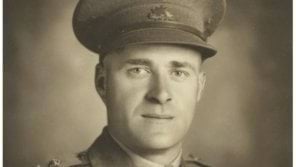
Brigadier Athol Earle Brown CMG OBE, a veteran of the Middle East campaign, played a pivotal role in commemorating the fallen. During the Second World War, he established and led the Directorate of War Graves Service. In 1946, he was appointed the first head of the Anzac Agency of the Imperial War Graves Commission.
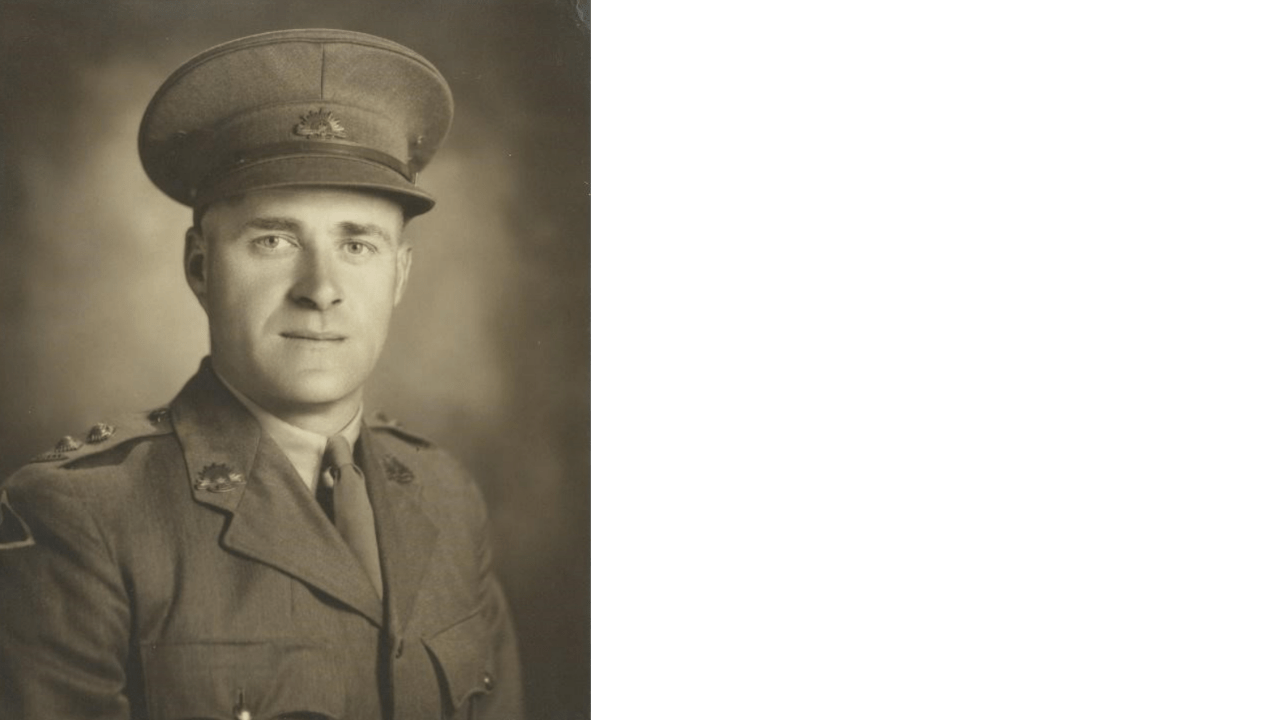
The Pacific War brought conflict to Australia’s doorstep, affecting life at home in unprecedented ways and leaving behind a devastating number of war dead whose burial and commemoration needed careful and sensitive consideration. One man would oversee efforts to both locate and identify the dead and create and beautify the war cemeteries we see today throughout Australia and around the Pacific. Yet despite his vital role in the war, he has gone largely unrecognised.
That man was Athol Earle MacDonald Brown CMG OBE, and much of his work during the war and in the decades after was carried out in the heart of Melbourne.
Born in January 1905 to William John Brown and Alice Catherine (nee MacDonald), Athol Earle Brown was employed as a company manager and company director throughout the 1930s. He married Millicent (Millie) Alice Heesh on 16 February 1929 and they had three children—Russell, William and Janet.
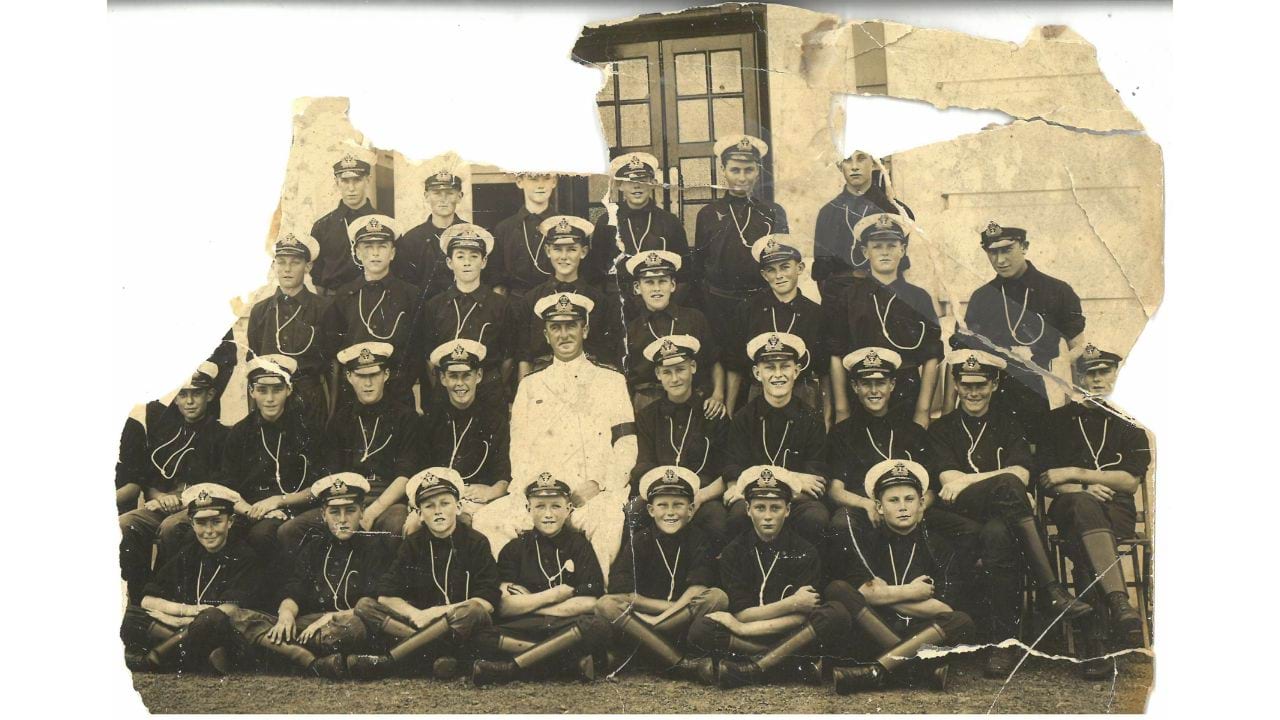
Brown’s first experience in the services was in the Royal Australian Navy Cadets from 1919 to 1923 when he was a boy. He later enlisted in the Royal Australian Artillery in the Middle East during the Second World War aged 35 years old. Ongoing illness saw Brown transferred to the Artillery Training Regiment at the end of May 1941, then to Records with the 2nd Echelon Headquarters base area before returning to Australia in July 1941.
Brown completed a Staff Captains’ course at Royal Park, Melbourne, in August 1941. While attached to Army Headquarters, Major (Temporary) Brown was appointed to raise the Directorate of War Graves Service (DWGS) on 16 March 1942, which he headed from its base at Victoria Barracks in St Kilda Road.
Australia had never dealt with war dead on such a scale. The scattered nature of the fallen added to the challenges faced in caring for them. As head of the DWGS, Brown was tasked with carrying into effect war graves policy on the ground during the war and in the early post-war years, and the creation and beautification of war cemeteries in the region.
He spent much of his time travelling around Australia, the Pacific and the Middle East inspecting war graves and cemeteries, including after the end of hostilities in August 1945. He visited areas where Australia’s war dead lay in significant numbers, particularly the remains of Australian POWs scattered along the Sandakan death march tracks and the Thai-Burma Railway, seeing for himself the challenges war graves men were facing on the ground.
Brown managed stakeholders with confidence and efficiency, from all levels of government and the Departments of Army, Air, and Navy in Australia, to foreign officials and the Imperial War Graves Commission (IWGC), particularly while negotiating policy. In 1944, he was called to London by Sir Fabian Ware, the man behind the creation of the IWGC, to discuss the state of war graves in the Middle East.
With Brown familiar with the Australian Government’s view on war graves policy, he was authorised to act on behalf of Australia during his visit. This would come to include discussions with UK authorities on establishing an Australian branch of the IWGC, something Brown had been strongly advocating for since 1943 amid discussions to break away from the IWGC and establish an independent Australian War Graves Commission.
In May 1946, Australian Prime Minister Ben Chifley announced that Brown had been appointed Secretary-General of the newly formed Anzac Agency of the Imperial War Graves Commission. Its purpose was to administer war graves in its own territories and beyond as an agency of the Commission. Brown was granted the rank of Honorary Brigadier upon his appointment.
Within weeks, Brown secured a lease in the Scott’s Building on Collins Street, from where the Anzac Agency first operated. He organised everything from typewriters and paper to the card index system and the necessary staff, before overseeing the transfer of responsibility of war graves and cemeteries from the Australian Army from September 1945. By May 1948, Brown announced that the Agency had completed the takeover of all war graves within its remit except the Yokohama War Cemetery, which was handed over in August 1948.
It was the bereaved who remained foremost in Brown’s mind. He continued to show enormous dedication to his administrative duties while also ensuring that veterans and families were kept informed of the progress of the Agency’s work. He corresponded with grieving relatives querying the efforts to find a lost loved one or the location of a war grave, or just how and when relatives would be able to visit the graves.
Brown appeared in radio broadcasts and often wrote articles on the progress of war cemeteries. In January 1962, he wrote in Reveille that the Port Moresby (Bomana) War Cemetery had an ‘atmosphere of dignity and tranquillity’ and that ‘the graves are carefully tended at all times’.
He also presented lectures and a film showing the beauty of war cemeteries to the public, commenting in 1951 in the Border Watch newspaper in Mount Gambier that,
‘The Commission does not aim to establish war cemeteries—our aim is to establish living memorials to those who are buried there’.
He firmly believed that only when war graves were thought of as memorials would their significance remain.
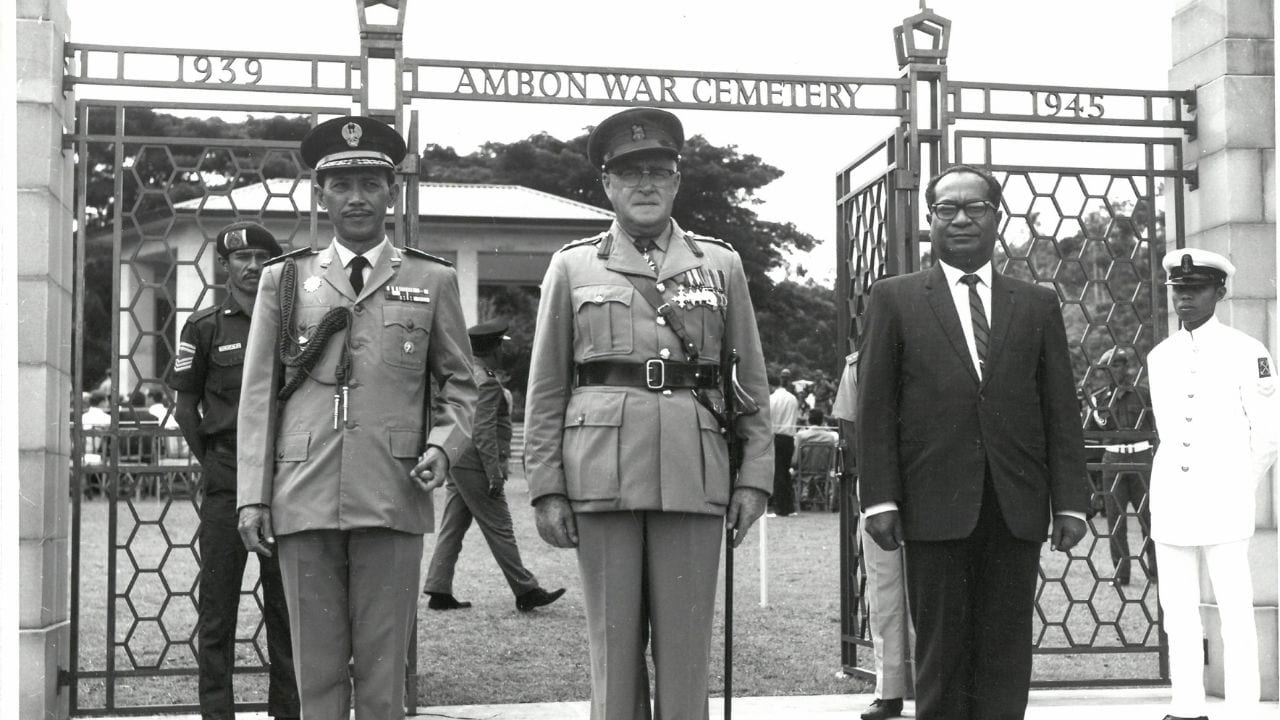
It was Brown’s ability to negotiate war graves agreements with several nations, including with decolonising nations and, most importantly, with Japan, that proved one of the most significant achievements for the Commission, ensuring the security and permanent construction of Allied war cemeteries.
Sent to Yokohama in August 1949, Brown met with Supreme Commander for the Allied Powers General Douglas MacArthur, who was steadfast in his desire to have all Allied war dead buried in Japanese soil exhumed and buried elsewhere in accordance with US policy. Brown explained the position of the IWGC and its founding principle of non-repatriation and, having received a very sympathetic hearing from MacArthur, managed to secure the Commission’s control over war dead in Japan.
The Mail newspaper in Adelaide once described Brown as ‘a quiet, grey-haired man’ who had ‘brought a lot of comfort to the relatives’ of Australia’s war dead. For his dedication to the fallen, Brown was made an Officer of the Order of the British Empire (OBE) Civil Division in the 1956 Queen’s Birthday Honours list. In 1964, he was also made a Companion of the Order of Saint Michael and Saint George (CMG) as part of the British Honours list.

Brigadier Athol Earle Brown OBE CMG retired from the Anzac Agency on 31 May 1969, having given ‘outstanding service to the Commission’. He had dedicated three decades to the memory and commemoration of Pacific War dead that saw him often spend extended periods of time away, domestically and overseas, from his wife, Millie, and their children. He died aged 82 on 5 August 1987.
In remembering their father, his surviving children, Bill and Janet, both thought he would be very happy with the attention he and his work were getting, adding, ‘We’re very proud to acknowledge him and send [his legacy] on to the next generation’.
Brigadier Athol Earle Brown’s legacy is easily recognisable in the very war cemeteries he spent his career caring for. His aspiration for these war cemeteries was a simple one, reported in The Courier-Mail in February 1948: ‘I hope that people in Australia will visit these places and see the beauty of these cemeteries for themselves’.
Author:
Dr Lisa Cooper is a historian and writer specialising in Australia’s experience of the Second World War. Lisa graduated with a PhD in 2023 with her thesis, A ‘most heartbreaking job’: caring for the dead of Australia’s war against Japan. Lisa’s thesis will be published by the Australian Army History Unit as part of the Australian Army History Series with Cambridge University Press.
Enjoyed this article? You might be interested in:
- Shrine Exhibition 'Eucalypts of Hodogaya' is showing until August 2025.
- Remembrance Magazine article from curator Neil Sharkey 'Eucalypts of Hodogaya'
Updated